
Opioid Stewardship Beyond Prescribing: Why Disposal Is the Missing Link Your Program Is Missing
Most opioid stewardship programs stop at the prescription pad. That gap, between what gets dispensed and what actually gets destroyed, is where diversion happens, where children get poisoned, and where rivers accumulate pharmaceutical contamination. Closing that gap requires treating medication disposal as a clinical and compliance priority, not an afterthought.
Opioid stewardship has matured significantly over the past decade. Health systems have invested heavily in prescriber education, prescription drug monitoring programs, and naloxone distribution. These are real, meaningful interventions. But the data keeps pointing to a blind spot: the drugs already in homes, already dispensed, already sitting in medicine cabinets. Most prescribing guidelines focus primarily on prescribing decisions rather than what happens to unused medication after it leaves the pharmacy.
For healthcare compliance officers, hospital pharmacists, and public health administrators, this is not an abstract policy problem. It is an active liability, a regulatory exposure, and a community health failure happening right now inside the patient populations you serve.
The Stewardship Model Has a Built-In Gap
Opioid stewardship, as most health systems practice it, is a prescribing-side discipline. It asks: who should receive opioids, at what dose, for how long? Those are the right questions. But stewardship frameworks rarely extend to the end of the medication lifecycle, which is the point at which unused pills become the most dangerous.
A National Survey on Drug Use and Health indicates that 40% of people who misuse prescription opioids get them from friends or family members, often from medications that were prescribed legitimately and simply not used up. That figure reframes the stewardship problem entirely. The pathway to misuse is not primarily illicit supply. It runs directly through legitimate prescriptions that were never properly disposed of.
A prescribing-only stewardship model treats the problem as if it ends at the pharmacy counter. It doesn’t. The medication lifecycle extends into the home, and that’s where the risk lives longest.
Why Take-Back Programs Aren’t Always Enough
Drug take-back programs play an important role in community drug safety. Retail pharmacy and mail-back options have expanded access, and they remain valuable public health tools.
But they also have structural limits. Participation is often low because patients face barriers like transportation, awareness, inconvenience, stigma, or timing. Take-back events may not align with when a patient finishes treatment.
They also create an interim custody issue. Until collected medications reach a licensed destruction facility, they remain intact and pharmacologically active. If the chain of custody fails, the drug is still usable.
Effective opioid stewardship requires an option that eliminates medication at the point of decision, in the patient’s hands, before it can be diverted, misused, or improperly discarded.
What Deactivation Actually Means
There is a meaningful difference between disposing of a medication and deactivating it.
Conventional disposal removes a drug from the patient’s possession, but the medication may remain intact until it is destroyed downstream. That means diversion risk can persist after the highest-risk period has passed.
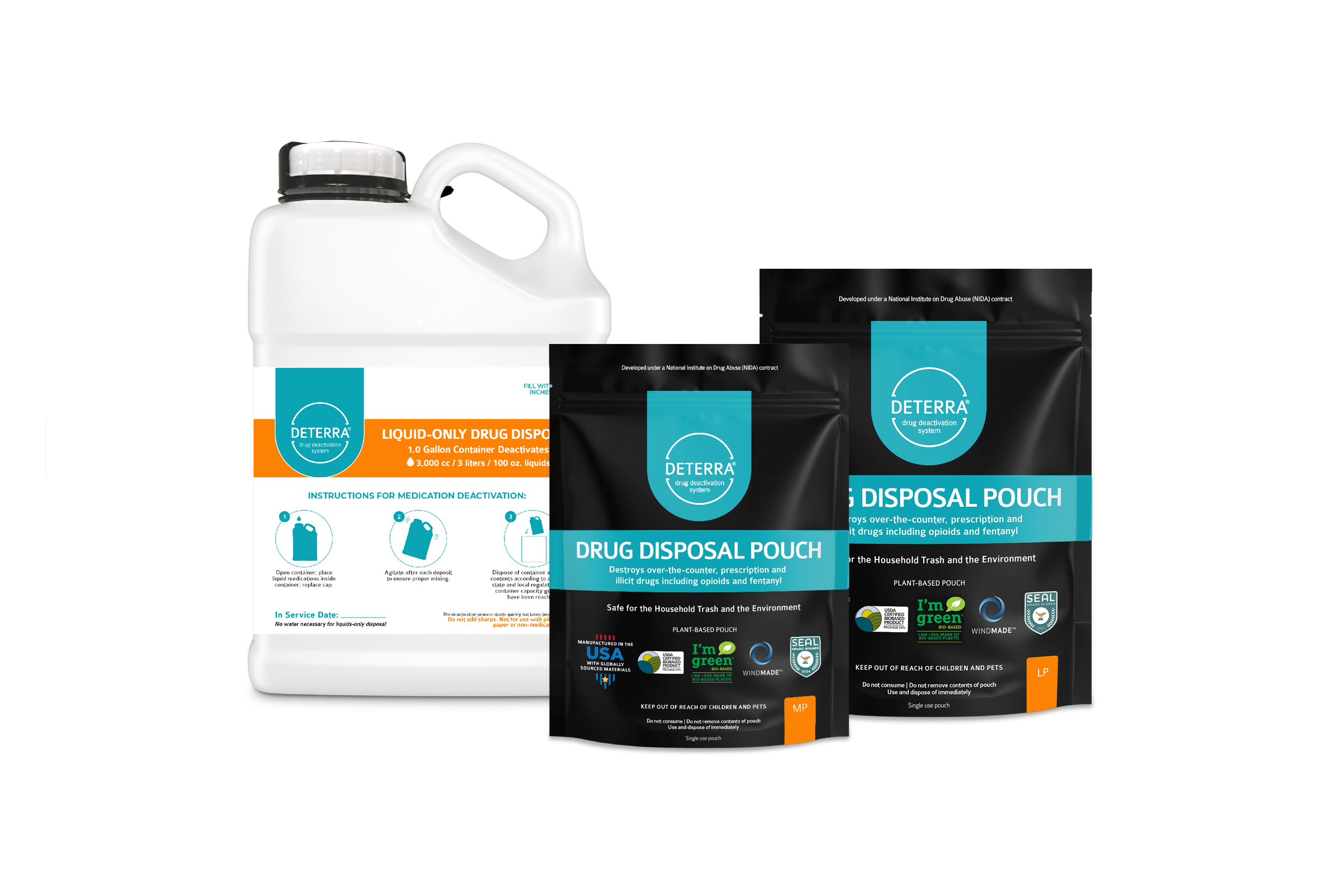
Deactivation eliminates that risk at the point of use. When a patient activates a Deterra pouch, the carbon-based formula binds to pills, patches, or liquids and renders them permanently unusable. The medication cannot be retrieved, reconstituted, or misused.
For healthcare compliance teams, that distinction matters. Deterra does not create a take-back workflow or chain-of-custody burden. It gives patients a way to deactivate medication at home, immediately, before it becomes a diversion risk.
Five Signals That Disposal Is Now a Stewardship Priority
The pressure to integrate disposal into opioid stewardship programs is coming from multiple directions simultaneously. Here are five signals that compliance officers and public health administrators should be tracking.
Regulatory scrutiny is intensifying. Common frameworks for controlled substance disposal continue to evolve, and health systems that cannot demonstrate patient-facing disposal protocols face increasing scrutiny during compliance reviews.
Joint Commission standards are expanding. Accreditation standards increasingly reflect a whole-lifecycle view of medication safety. Discharge planning that includes unused medication disposal is becoming an expectation, not a differentiator.
Litigation risk is real and growing. Health systems have faced legal exposure related to opioid diversion originating from prescribed medications. Demonstrating that your institution actively provided patients with effective disposal tools is a concrete risk mitigation step.
Payer and value-based care frameworks are shifting. As health systems accept more downstream accountability for patient outcomes, the community health consequences of opioid misuse flow back to the institution. Preventing post-discharge diversion is a financial interest, not just an ethical one.
Community trust is on the line. In communities hit hard by the opioid epidemic, health systems that are seen as passive about post-prescribing risk face real reputational damage. Proactive, science-backed disposal programs signal institutional accountability.
Building Disposal Into Your Stewardship Program
The practical question for compliance officers and pharmacists is how to operationalize this. A few concrete approaches:
- Point-of-prescribing distribution. When a clinician prescribes an opioid, a Deterra pouch can be provided at the same encounter. This pairs the prescription with its end-of-life solution and captures the moment when the patient is most engaged with the clinical conversation.
- Discharge protocol integration. For inpatient settings, including a Deterra pouch in the discharge package for patients receiving opioid prescriptions is a low-friction, high-impact intervention. It requires no follow-up visit, no mail-back logistics, and no chain-of-custody management.
- Pharmacy-level distribution. Retail pharmacy chains and hospital outpatient pharmacies can include Deterra pouches at the point of dispensing, creating a direct link between the drug and its deactivation tool.
- Community health programs. For public health administrators running opioid response programs, Deterra pouches can be distributed through community health workers, harm reduction programs, and primary care settings to reach populations that are unlikely to use take-back kiosks.
Each of these models works because deactivation happens at the patient level. You are not building a collection infrastructure. You are enabling the patient to eliminate the risk themselves, with a tool that is scientifically proven to work.
The Recommendation Your Program Needs to Act On Now
Audit your current discharge protocol for opioid prescriptions. Ask specifically: at what point does a patient receive instruction on unused medication disposal, and what mechanism do you provide them? If the answer is a pamphlet directing them to a take-back event, your stewardship program has a gap that no amount of prescribing precision can close.
The clinical field is moving toward individualized, multimodal acute pain management. That is the right direction. But individualized prescribing means individualized surplus, and individualized surplus requires a disposal solution that works at the individual level, in the patient’s home, without depending on institutional infrastructure or patient follow-through on a future action.
The Program You Build Today Strengthens Stewardship Tomorrow
Opioid stewardship does not end at prescribing. Once medications leave the pharmacy, patients still need a practical way to manage what remains.
For healthcare compliance officers, hospital pharmacists, and public health administrators, point-of-use deactivation can help close that gap. It gives patients a way to deactivate unused medication at home, before it can be misused, diverted, or improperly discarded.
Adding deactivation to a stewardship program supports a fuller medication lifecycle approach: prescribe responsibly, educate clearly, and help patients safely deactivate what is left.