What Is a Drug Deactivation System and How Does It Differ from Standard Disposal Methods
A drug deactivation system is a product or technology that chemically neutralizes medications, rendering them permanently inert and non-retrievable rather than simply moving them to another location. Unlike approaches that depend on transporting or obscuring unused medication, point-of-use deactivation is designed to address the drug at the source, before it can be diverted or improperly discarded. That distinction has direct consequences for opioid diversion risk, environmental liability, and regulatory compliance.
If you are a healthcare compliance officer, hospital pharmacist, or public health administrator, understanding the difference between disposal and deactivation can help organizations build more complete medication-safety and stewardship programs.
What Standard Disposal Methods Actually Do
Most conventional approaches to unused medication disposal fall into a few categories: drug take-back programs, collection kiosks, flushing, and household trash disposal with mixing agents like coffee grounds or cat litter.
Each has a fundamental barrier. They either require the patient to take an action they often never take, or they move the medication somewhere else without neutralizing it.
- Drug take-back programs depend on patient compliance. Most unused prescriptions sit in medicine cabinets between collection events.
- Collection kiosks require proximity and access. While these are valuable, rural communities, elderly patients, and people with limited mobility are typically underserved.
- Flushing is recommended only for a narrow list of high-risk medications, and it introduces pharmaceutical compounds directly into waterways. The U.S. Geological Survey has detected pharmaceuticals in surface water across the country, including hormones, antibiotics, and opioids.
- Trash disposal with household waste obscures medications but does not neutralize them. A determined person can still retrieve and misuse them.
None of these methods deactivate the drug itself. They relocate it or obscure it. The molecule stays intact.
How a Drug Deactivation System Works Differently
A drug deactivation system uses a chemical mechanism, typically activated carbon or a similar sorbent material, to bind drug molecules and render them biologically unavailable. When used as directed, the system is designed to make the medication non-retrievable and unavailable for misuse while reducing the potential for pharmaceutical compounds to enter the environment.
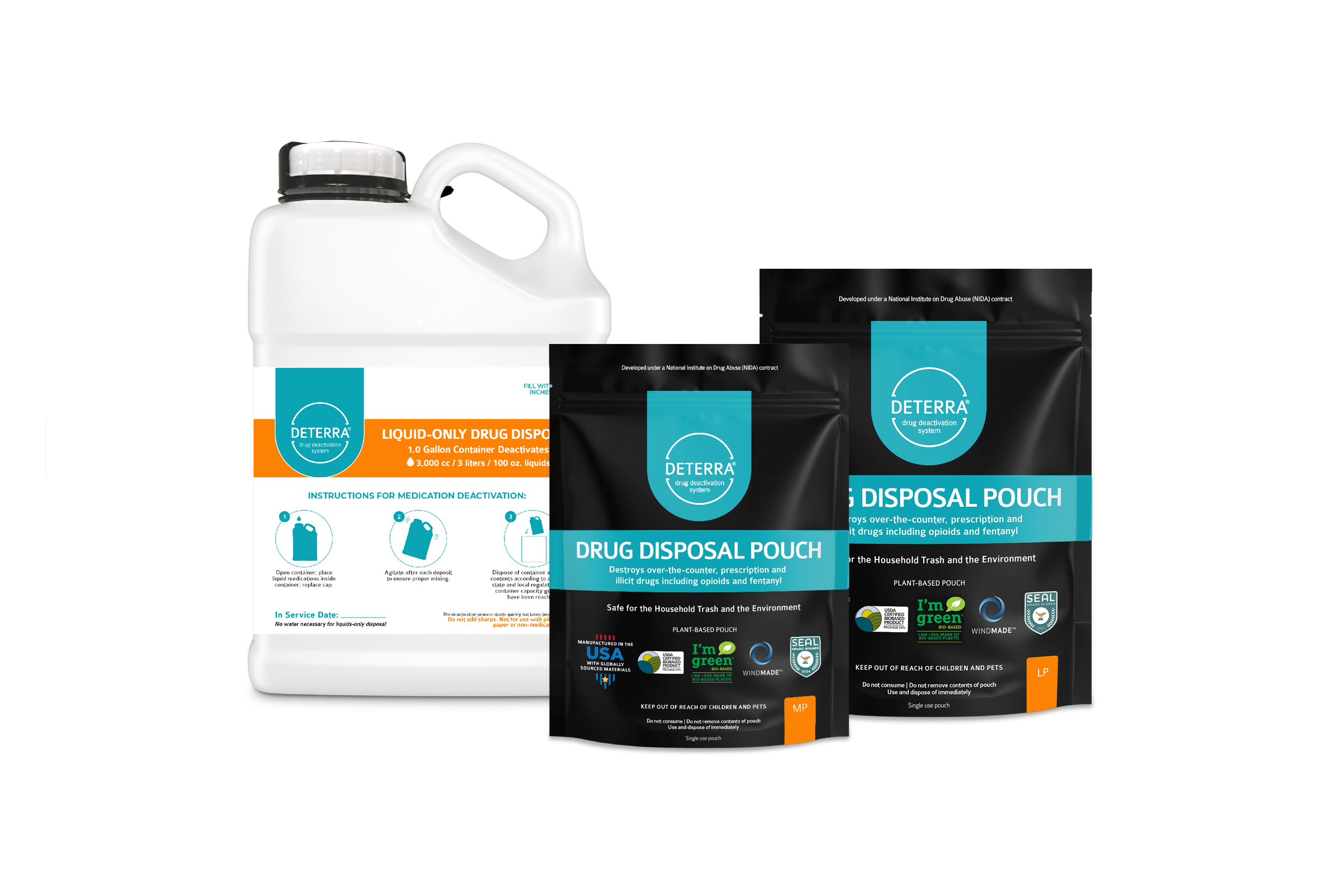
Deterra’s drug deactivation pouches use a patented carbon-rich formula. When a medication is added to the pouch with water, the activated carbon adsorbs the drug compounds at the molecular level. The result is a stable, non-hazardous material that can be disposed of in household trash without environmental risk or diversion potential.
Drug-disposal products do not all work the same way. Some are designed primarily to contain medications, while others use an adsorptive or deactivation mechanism. Organizations should review each product’s independent testing, instructions for use, drug capacity and disposal requirements.
When evaluating a drug deactivation system, look for::
- Uses a scientifically validated mechanism to neutralize drug compounds
- Renders medications non-retrievable and non-misusable after treatment
- Works for multiple drug forms: pills, capsules, liquids, and patches
- Can be used at the point of care or in the home without specialized training
- Produces a non-hazardous output that does not require special waste handling
Why Healthcare Organizations Are Paying Attention Now
A 2019 population-based study of 2,392 surgical patients found that patients used only 27% of the opioids prescribed to them, leaving a substantial amount unused. Other research has reported proper disposal rates below 10% among adults and children with leftover postoperative opioids.
For healthcare compliance officers, that data point is a policy problem. For hospital pharmacists managing discharge protocols, it is a patient safety gap. For public health administrators running opioid stewardship programs, it is a community risk that lands back on their desk.
Drug take-back infrastructure helps, but it does not reach every patient at the right moment. A drug deactivation system addresses that gap by meeting patients where they are, at home, at the time of disposal, without requiring a trip to a collection site. Deterra pouches are designed for this exact scenario, practical enough to include in a discharge packet and backed by scientific testing as a point-of-use medication deactivation option.
The Standard Has Changed
Prescription drug disposal used to mean getting medications out of the home. That standard is no longer the only option. Health systems, public health agencies, and retail pharmacies are accountable for what happens to those medications after they leave the patient’s hands.
A drug deactivation system is not a marginal upgrade over a take-back program. It is a different category of solution. It works at the point of need, neutralizes the drug rather than relocating it, and produces a demonstrably safer outcome for patients, communities, and the environment.
The question worth asking inside any health system running an opioid stewardship program: are your current prescription drug disposal protocols actually eliminating the risk, or are they just moving it somewhere less visible?