Inspira Health, a leading nonprofit healthcare organization with over 200 locations in New Jersey, has been providing the Deterra® Drug Deactivation and Disposal System to individuals, coalitions and partner agencies since 2016 to help lower the supply of unused medications available for misuse, theft or accidental ingestion.
Wendy Rosen, MSN, RNC, the Maternal-Newborn Clinical Nurse Educator at Inspira Medical Center Mullica Hill, observed that nearly all C-section patients receive an opioid prescription but no information about how to properly store or dispose of their medications.
In 2019, Rosen led a study to determine if providing new moms with medication safety education and Deterra for proper at-home drug disposal would increase proper disposal behavior and ultimately help eliminate the availability of unused opioids in the community.
“What we found is that the group provided with Deterra Pouches was three times as likely to properly dispose of leftover opioids as the control group. Not only that, but patients used Deterra for other unwanted medications in their homes and requested additional pouches for future use,” says Rosen.
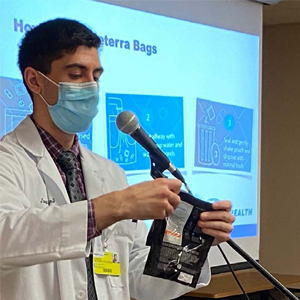
The disposal study was conducted over three years with C-section patients prescribed opioids. Participants were randomly assigned to an intervention group or a control group. The intervention group received education on safe opioid use and a Deterra Pouch, which allows users to deactivate and dispose of unused drugs at home with the simple addition of tap water. The control group received standard discharge instructions. Both groups were surveyed about their disposal behavior within two weeks of discharge.
“Most C-section patients don’t finish their prescriptions, but they can’t drive for two weeks post-procedure so it’s harder to get to a take-back location,” Rosen says. “Plus, they often have other young children in the home for whom these medications could be extremely dangerous. We wanted to see if these patients would use an easy at-home option that’s disposable in the normal trash.”
The study found over 46% of the intervention group properly disposed of unused opioids compared to 14% of the control group. In addition, intervention group members reported they used Deterra to deactivate and dispose of other household medications.
“Participants started asking for more pouches for their family members and future use,” Rosen says. “They also cited the environmental aspect, because they didn’t realize they shouldn’t be flushing medications or just throwing them away.”
With the success of Rosen’s study, Inspira will expand its use of Deterra Pouches to all surgical centers network-wide and increase community distribution through behavioral health departments, pharmacies, community partners, health fairs and online requests.
“When I think big picture, I think that when you get a prescription – especially for a controlled substance – it will be standard practice to get a Deterra Pouch with it,” says Megan Allain, MPH, CHES, director of community impact for Inspira. “We know not everyone finishes their prescriptions, and this is such a simple way to keep medication out of the wrong hands and protect the environment.”
“Providing Deterra is setting an evidence-based standard of care,” Rosen says. “This is something that others across the country should be doing to meet community and patient needs for proper medication disposal.”
Visit DeterraSystem.com/government to explore how other organizations are using Deterra or reach out to (612) 568-1128 or Sales@DeterraSystem.com to discuss how to implement at-home drug disposal initiatives in your community.