The latest data from the CDC shows opioid prescribing rates remain high: over 168 million prescriptions were written in 2018- yet over 3 billion pills went unused in the U.S. alone.
According to an analysis from the New England Journal of Medicine, the opioid crisis arose in part because physicians were led to believe the risk of opioid addiction was low. This mis-information came from a brief letter published in The Journal in 1980 stating that the risk of opioid dependence was rare in hospitalized patients prescribed opioids. Called “Porter and Jick,” this letter was merely an observational account of a handful of hospitalized patients. Pharmaceutical companies, however, referenced this “landmark study” extensively while selling the idea to doctors that opioids were entirely safe and non-addictive.
Dr. Greg Colbath, an orthopedic surgeon at Spartanburg Regional in South Carolina, took note of the increasing prescribing patterns in his community after seeing opioid dependence firsthand with many patients who were seeking surgical interventions for their musculoskeletal conditions. His awareness of this crisis grew while reading Dreamland: The True Tale of America’s Opiate Epidemic by Sam Quinones, a book recommended to him by a local legislator involved with opioid abuse prevention policies.
“No one has ever died from pain alone, but thousands of people have succumbed to opioid addiction or died from well-meaning attempts to alleviate pain,” says Dr. Colbath. “Healthcare providers have the unique ability to prevent a patient from becoming an addict through opioid safety and pain management education.”
Dr. Colbath decided to use his platform as a medical professional in small-town America to inform colleagues, administrators and the public about the benefits of opioid reduction strategies for surgery and tools to prevent opioid addiction.
“It’s important to understand that, as a treating physician, we have the ability to say ‘no’ to prescribing opioids or narcotics if we feel they are not warranted. We can implement multimodal pain strategies that are opioid-free or opioid-sparing,” says Dr. Colbath. “But if you do feel a condition warrants an opioid prescription, every physician must understand that they play a crucial role in preventing prescription drug abuse.”
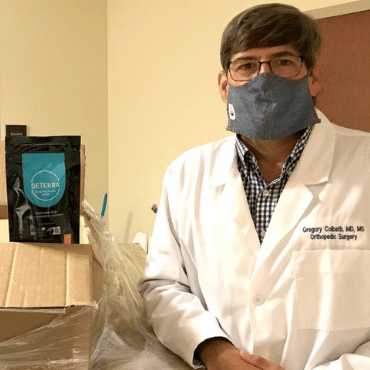
To lessen the role of opioids in patient care, Dr. Colbath has taken measures to reduce the abuse and misuse potential of opioids for pain control in orthopedic surgery. After observing how Twin Cities Orthopedics in Minnesota utilized the Deterra® Drug Deactivation and Disposal System, Dr. Colbath decided to ramp up his drug abuse prevention efforts. His clinic dispenses Deterra Pouches to every patient at their pre-operative visit, providing them with an easy, at-home option for safe disposal of leftover opioids.
“With the Deterra Pouches I am able to provide my patients and their families with a drug abuse prevention resource that is easy-to-use, convenient and tangible. It’s something they can use in the privacy of their homes to eliminate the opportunity take their prescription when it’s no longer needed,” says Dr. Colbath. “Helping patients understand the harm that leftover pain medications can cause is a crucial first step. When patients understand the risk that their leftover medications might be misused by family members, especially younger ones, they start to listen.”
Dr. Colbath highlights and provides Deterra Pouches at speaking sessions with medical professional at numerous community and corporate engagements. He has had nearly 100 speaking requests in the last three years from all sectors of the community and was recently invited to share his experiences with the South Carolina Governor’s Opioid Conference.
In addition to spearheading this safe medication disposal initiative, Dr. Colbath uses a long-acting surgical site analgesic injection to reduce opioid reliance and consumption in the first few days after surgery- critical days when a patient’s pain is highest. He has also served on several scientific advisory boards with key opinion leaders to formulate best practices for implementing multimodal strategies and opioid sparing alternatives in the surgical setting.
“Churches, school districts, corporations, worker’s compensation groups, civic organizations and our local colleges have all seen the impact of opioid abuse in our community. They are all looking to the medical community for prevention and reduction strategies that are tested and effective.”
Dr. Colbath has been using Deterra Pouches for two years and recently received a $20,000 grant through the Spartanburg Regional Foundation to provide Deterra Pouches to all of his surgical patients who require an opioid prescription.
To assess the effectiveness of his opioid awareness discussions and Deterra Pouch program, Dr. Colbath recently conducted a survey at the first three-week post-operative visit. He found 100% of his patients felt their post-operative pain had been adequately treated and, on average, they required only seven narcotic pills – while many took none at all. On average, patients rated their pain score as 2/10 and 75% of the respondents said they had used or planned to use the Deterra Pouches to remove unused pills from their household.
“I was really encouraged at these results- it confirmed to our team that we can reduce opioid use in the community and at the same time optimize our patients’ post-operative outcomes,” says Dr. Colbath.
Visit DeterraSystem.com/government to explore how other organizations are using Deterra or reach out to (612) 568-1128 or Sales@DeterraSystem.com to discuss how to implement at-home drug disposal initiatives in your community.