For several years, the Forsyth County Drug Awareness Council has operated a drug take back day event, giving residents of the suburban Atlanta community a way to dispose of unused or expired medications.
“But during COVID-19, the numbers started to drop off,” says Vinayak Menon, a junior at Lambert High School and the council’s Youth Sector Leader.
While drug take back participation decreased, the number of overdoses in Georgia spiked. Between 2019 and 2020, opioid overdose deaths rose 36% in Georgia, and many metro Atlanta counties saw fentanyl-involved deaths double or triple.
“The drug take back day program was a great step, but when I was standing there and volunteering, I realized there were limitations,” Menon says.
Some residents lacked transportation or were unable to take off work to attend a take back event. Others might avoid an event because of stigma associated with publicly dropping off a large amount of prescriptions.
“I was thinking, how do we make this really important process — getting medications out of home medicine cabinets — more convenient?” Menon says.
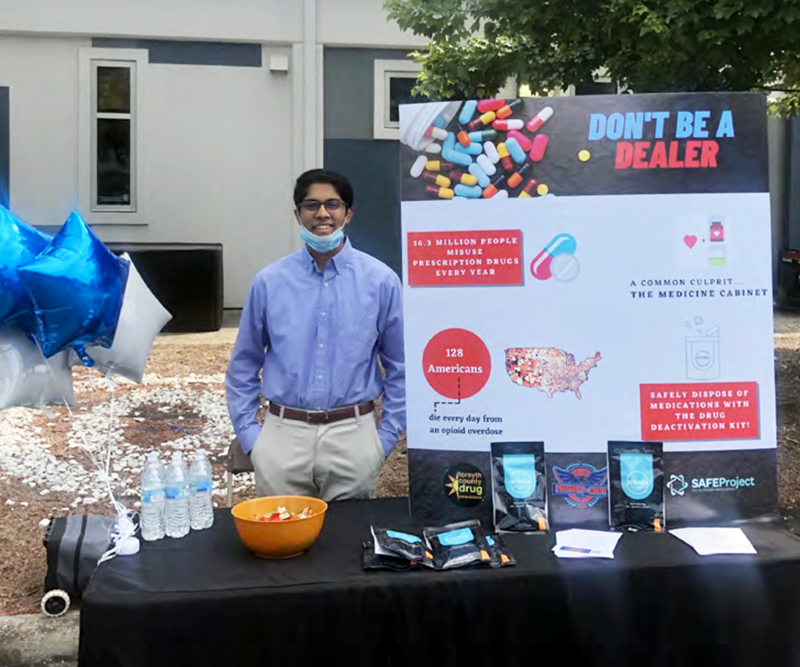
Menon began searching for ideas on the CADCA (Community Anti-Drug Coalitions of America) website. He soon connected with the Massac County Drug Awareness Council out of Illinois, which ran a drug disposal campaign giving out Deterra® Drug Deactivation and Disposal Pouches to community members.
Deterra Pouches use tap water and activated carbon to deactivate harmful chemicals in medications and make them irretrievable and safe to toss in household trash without harming the environment.
Massac County gave Menon the name of a few nonprofits he could work with to get an initial donation of pouches for Forsyth County to try. “I connected with SAFE Project and told them my vision and how I could take this program and scale it in North Georgia,” he says. “They were really, really supportive.”
After SAFE Project donated pouches, Menon created a distribution plan and targeted the three main sources of prescription drugs in Forsyth County:
Menon also worked to engage local communities of color, who have often been left out of discussions around drug misuse. “A main goal of this deactivation campaign is to be as inclusive and accessible as possible to all communities,” he says. “I want to bring in stakeholders that are incredibly diverse. Some of the great partners we’ve had to engage black and brown communities, especially in rural areas, are faith-based organizations.”
During his summer 2021 break, Menon spent time driving around his community and distributing Deterra Pouches so organizations, like Northside Hospital, The Place of Forsyth County, and local food pantries could hand them out to residents.
As of fall 2021, Forsyth County Drug Awareness Council has received nearly 5,000 donated Deterra pouches, and Menon has already distributed 3,750 pouches so far, enough to get rid of nearly 330,000 pills in his community.
“The end goal of this strategy is to create a behavior change,” he says. “I’m hoping that part of this campaign is not just putting these pouches in people’s hands but expanding awareness, so people are actively thinking about drug disposal campaigns and continue to dispose of these meds to protect their families.”
Menon has also had conversations with other community organizations about expanding the campaign into the cities of Atlanta and Johns Creek.
His current goal is to hand out 10,000 pouches. “If we can do 10,000 pouches, we’re getting close to destroying about 1 million pills in my community,” he says. “But that’s not the end; the sky’s the limit.”
Visit DeterraSystem.com/government to explore how other organizations are using Deterra or reach out to (612) 568-1128 or Sales@DeterraSystem.com to discuss how to implement at-home drug disposal initiatives in your community.